AgentsView: a local analytics runtime for 27 coding agents — tonight's pick
kenn-io/agentsview: Go CLI + dashboard that indexes 27 agents into SQLite, tracks costs 80–220× faster than ccusage. v0.33.0 out today.

研究速览
Tonight's pick:
kenn-io/agentsview — a local-first Go CLI + web dashboard that auto-discovers and indexes sessions from 27 coding agents into a SQLite database, then gives you full-text search, per-session cost breakdowns, and usage analytics. ~2,000 GitHub stars in roughly 10 hours. MIT license. 1Note on categorization: agentsview is not a traditional Agent Skill — it has noSKILL.md, is not listed on skills.sh, and is not installed vianpx skills add. It's a standalone binary that sits alongside your agents and observes them. That's the correct frame for evaluating it.
| Field | Value |
|---|---|
| Repo | kenn-io/agentsview |
| Author | Wes McKinney (creator of pandas, founder of kenn-software, GP at Composed Ventures) |
| License | MIT |
| Latest version | v0.33.0 (Jun 12, 2026) |
| Stars / forks | ~2,000 / 191 1 |
| Supported agents | 27 (Claude Code, Codex, Gemini CLI, Cursor, OpenCode, OpenHands, Amp, Kimi, Qwen Code, Forge, Warp, Zed, and more) |
| Backend options | SQLite (default), PostgreSQL (team push), DuckDB (v0.33.0 mirror) |
| Runtime | Go 1.26+ with CGO; pre-built binaries available |
What it actually does
Most tools in the coding-agent space focus on what agents produce — better output, stricter guardrails, enforced reasoning patterns. agentsview ignores all of that and focuses on what agents consume: your tokens, your time, your costs.
It works by watching the session directories that coding agents already write to disk. On first run,
agentsview serve scans your machine, finds every agent session it recognizes across the 27 supported tools, and syncs them into a local SQLite database with FTS5 full-text indexing (SQLite's built-in search engine). No config file, no API key, no setup wizard. As Wes McKinney described the design intent: 2"A new pattern is emerging for apps that 'just work' with your agents. AgentsView just used my local Claude Code and I didn't even have to set anything up."
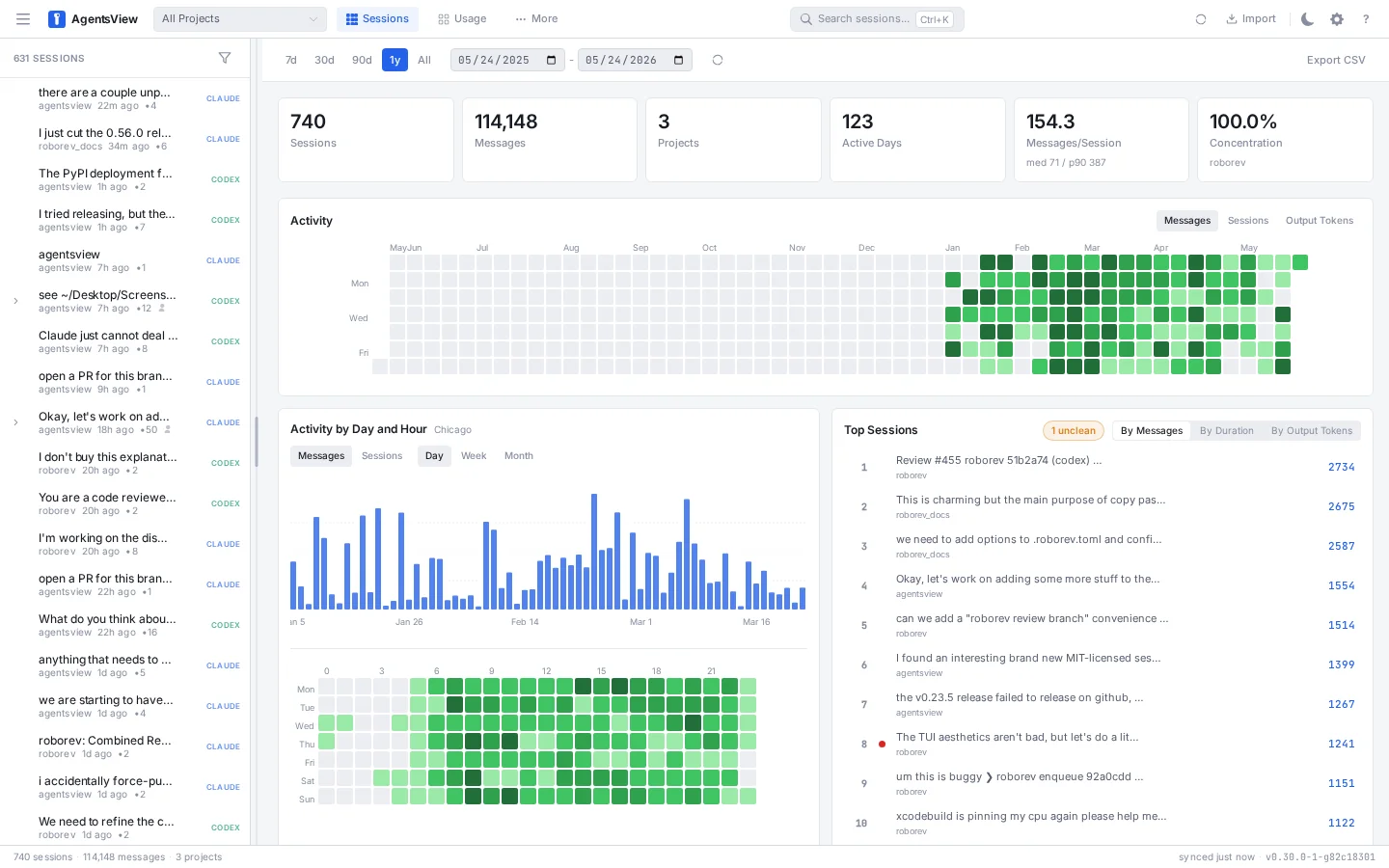
The resulting dashboard gives you five types of signal: a yearly activity heatmap (messages by weekday × month), an hourly activity grid, per-session cost estimates using LiteLLM pricing rates (an open-source library that maintains a unified model-price table for 100+ LLMs), a full-text search across all your agent conversations, and a top-sessions leaderboard ranked by messages, duration, or output tokens. 1

The cost engine is cache-aware. It distinguishes between cache-creation tokens and cache-read tokens, and applies the correct pricing tier for each. When a model isn't in the pricing database yet — Simon Willison hit this with Claude Fable 5 — you can add a custom entry via config. Willison found that a single project (
prod_datasette_agent) had consumed $74.06 on one day, with cache savings of $516.62 offset against that. 3What's new in v0.33.0 (released today)
v0.33.0 dropped this morning with several additions worth knowing: 4
- DuckDB mirror backend + Quack protocol: sessions can now be mirrored to a DuckDB file or served via the Quack remote-access endpoint (DuckDB's wire protocol for remote SQL queries), enabling SQL analytics directly on your agent session corpus
- Command Code and Zed AI assistant support: two new agents in the index
- Session publishing to GitHub Secret Gist: share a session log without making it fully public
- Windows ARM64 native binary and PyPI wheels: first-class ARM Windows support
- Claude Fable 5 fallback pricing: the pricing database now covers Fable 5 natively
- Antigravity CLI token extraction and trajectory sideloading: extended support for Antigravity agent sessions
- Configurable remote host for
agentsview sync: sync to a remote rather than only local
How to install
Five paths, ranging from zero-install to desktop app:
Option 1 — curl (fastest for one-off)
curl -fsSL https://agentsview.io/install.sh | bashOption 2 — Homebrew cask (macOS)
brew install --cask agentsviewOption 3 — pip / uvx (recommended for Python-first environments)
pip install agentsview
# or, without permanent install:
uvx agentsview serve
Option 4 — Docker
docker run -p 8080:8080 ghcr.io/kenn-io/agentsview:latestOption 5 — Desktop app (Tauri-wrapped, auto-updates)
Download the
.dmg (macOS), .exe / ARM64 (Windows), or .AppImage (Linux) from GitHub Releases. The official site describes the desktop app as the recommended path. 5Once installed, start the server:
agentsview serve
# opens http://127.0.0.1:8080 — the server binds to localhost only by default
Usage examples
Daily cost check — the command that started the tool's reputation:
agentsview usage daily
# shows last 30 days of per-day cost totals

agentsview usage daily --breakdown
# breaks each day down by model

agentsview usage daily --since 2026-05-04 --agent claude
# filter to a specific agent and date range
Simon Willison uses this regularly to check what the API-price equivalent of his Claude Code usage would be. 3
"Run 'uvx agentsview usage daily --since 2026-05-04' to see how much that would have cost you in API costs (the price Uber pay) as opposed to just your individual subscription costs." 3
Status line for your terminal prompt — a single-line today-so-far summary you can pipe into tmux or a shell prompt:
agentsview usage statuslineWindowed analytics report:
agentsview stats
# prints: total sessions, prototype distribution, average duration,
# peak context size, cache economics, hourly activity breakdown
Per-session deep dive:
agentsview session usage <session-id>
# token counts + cost estimate for one session
Team PostgreSQL push (for shared visibility across machines):
agentsview pg pushDuckDB mirror (new in v0.33.0 — run SQL directly against your session corpus):
agentsview duckdb push    # mirror to a local DuckDB file
agentsview duckdb serve   # start a Quack endpoint for remote access
banteg (yearn Finance core contributor, 225K followers) described the workflow: 6
"quite a nice tool for understanding agent usage and trends, you can plot by project/model/harness. then you can also do funny trend analysis for model tic words."
What the community says
The reaction this week has a specific quality to it: engineers who already use multiple agents simultaneously treating agentsview as filling an obvious gap they hadn't articulated yet.
prince (@prince_twets, AI engineer at a YC company) put it plainly: 7
"agentsview caught my eye today. I like that it indexes local agent sessions into SQLite, then gives a usage UI plus a 100x faster ccusage replacement across Claude Code, Codex, and 20+ agents. Feels inevitable."
The performance comparison with
ccusage is one of the concrete selling points in the README: on a 22,000-session local database, agentsview usage daily runs 80–220× faster than npx ccusage@latest daily, because agentsview queries a pre-indexed SQLite database rather than re-parsing raw JSONL on every call. 1Rajiv Shah (OpenHands engineer, @rajistics) added OpenHands support to the project and framed the value of cross-agent visibility: 8
"Agentsview is a local-first, open-source way to view agent activity across your coding tools, including Claude Code, Codex, and now OpenHands. That makes it much easier to search, review, and summarize what your agents are doing."
The Chinese-language AI community picked it up independently. @ai_xiaomu (Huang Xiaomu, 34K followers) described the problem it solves: 9
"一个工具解决了 AI 编程的一个隐形痛点" — a tool that addresses the invisible pain point of AI coding: knowing which session burned the most tokens, which task the agent handled worst, and what kept requiring rework. 9
正在加载内容卡片…
Known limitations
Open issues to know about before committing:
- #655 (Jun 12): Two machines pushing to the same PostgreSQL database can produce silent merges and ping-pong conflicts when session IDs collide. The multi-machine shared-database mode isn't production-ready yet. 10
- #643 (Jun 11): Codex fork sessions are double-counted in usage totals. 10
- #639 (Jun 11): Cowork conversation statistics are missing. 10
- Token Usage feature is still marked "maturing": the README explicitly flags this — expect rough edges in edge-case pricing scenarios. 1
- Bus factor: Wes McKinney is the primary author. The repo uses Renovate for automated dependency updates and has active CI/CD, but core feature decisions are single-author for now. 1
- No Reddit discussion found: as of Jun 12, no threads on r/ClaudeCode, r/ClaudeAI, or r/CodingAgents. Community signal is concentrated on X and GitHub.
When NOT to use this
Skip it if:
- You use a single agent and don't need cross-agent visibility. The value scales with the number of agents you have running simultaneously. If you're Claude Code-only,
ccusagecovers the cost-tracking need with less setup overhead. - You need team-wide shared analytics right now. The PostgreSQL push path exists, but issue #655 shows it has a merge-conflict problem that the team hasn't resolved yet. Hold off on deploying this to a shared team database until that's fixed.
- Your environment is air-gapped or has strict network policies. The anonymous telemetry is opt-out, not opt-in, so you'll need to explicitly disable it — check the config options before deploying in a locked-down environment.
- You were hoping for this to be an Agent Skill you can drop into Claude Code via
npx skills add. It isn't. There's no SKILL.md. It won't intercept your agent's behavior or add guardrails. It only observes.
Use it if:
- You run Claude Code, Codex, Gemini CLI, or any combination of 27 agents and genuinely don't know which sessions are consuming the most cost.
agentsview statswill tell you within seconds of first launch. - You've been using
ccusageand find it slow on large session archives. The 80–220× speedup claim is based on a 22,000-session dataset — at that scale, the SQLite pre-indexing approach has a clear practical advantage. - You want a searchable history of everything your agents have ever done, organized by project. The FTS5 full-text search covers all your Claude Code, Codex, and other agent conversations in a single query interface.
- You're building something on top of agent session data — the new DuckDB Quack endpoint in v0.33.0 means you can run arbitrary SQL against your session corpus without writing a parser.
Install it now
# Quickest no-install test:
uvx agentsview serve

# macOS permanent install:
brew install --cask agentsview

# Cross-platform:
curl -fsSL https://agentsview.io/install.sh | bash

# Start the dashboard:
agentsview serve
# → http://127.0.0.1:8080

# Daily cost check:
agentsview usage daily --breakdown
Official site: agentsview.io
Full repo: github.com/kenn-io/agentsview
Cover image: AgentsView dashboard screenshot (kenn-io / MIT)
参考来源
- 1GitHub — kenn-io/agentsview
- 2@wesmckinn on X — AgentsView v0.22.0 announcement
- 3Simon Willison's Weblog — TIL: Setting a custom price for a model in AgentsView
- 4GitHub — Release v0.33.0 · kenn-io/agentsview
- 5AgentsView — Official website
- 6@banteg on X
- 7@prince_twets on X
- 8@rajistics on X
- 9@ai_xiaomu on X
- 10GitHub Issues — kenn-io/agentsview
围绕这条内容继续补充观点或上下文。