The Boy in the Red Beret: Pontormo's Portrait of a Halberdier
Pontormo painted this teenager during Florence's last republican siege in 1529–30; five centuries later, scholars still disagree whether the boy is a citizen-soldier or a future Medici duke. The Getty bought the painting for a world-record $35.2 million in 1989.

The Boy in the Red Beret: Pontormo's Portrait of a Halberdier and Its 460-Year Secret
There is something slightly wrong with this painting, and that is precisely what makes it unforgettable.
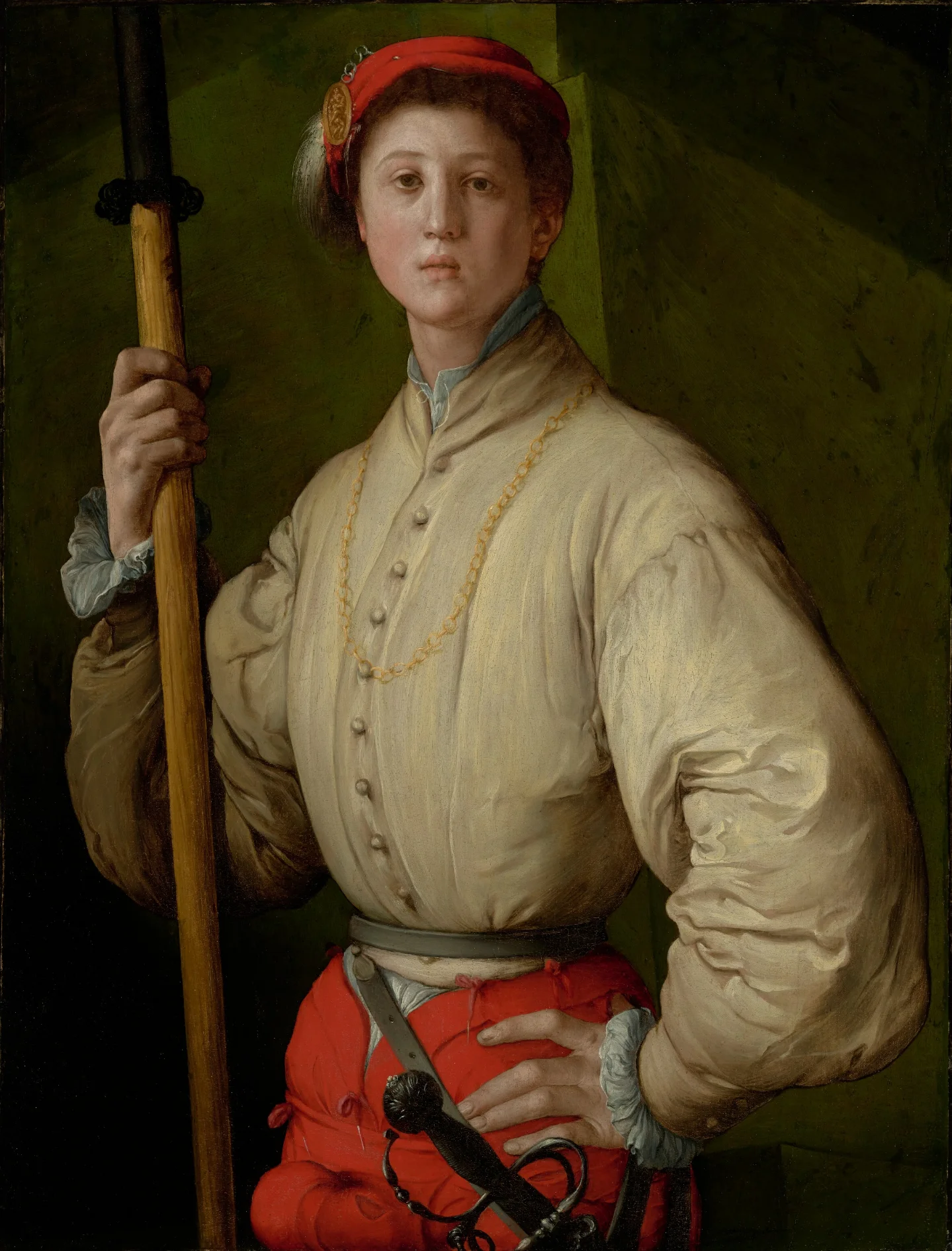
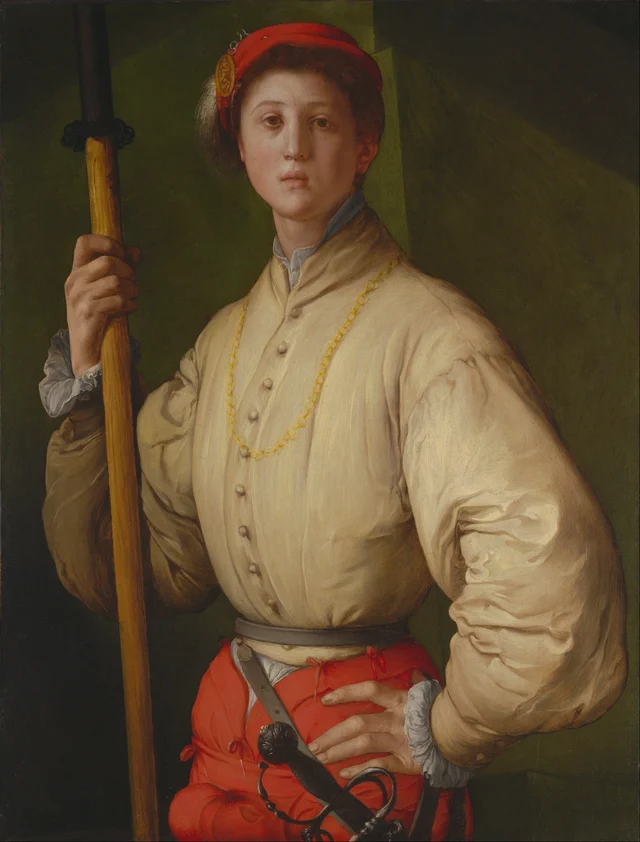
The young man stands before a dark green fortress wall, right hand gripping a halberd — the steel-tipped pole-arm that serves as both weapon and badge of rank — left hand resting on the pommel of a sheathed sword. He wears scarlet breeches and a pale tunic fastened with a column of ivory buttons. A gold chain loops across his chest. His red beret carries a gold medallion stamped with Hercules wrestling Antaeus. He cannot be more than fifteen or sixteen years old. 1
He stares straight at you. The stare is the problem. It has the swagger of a veteran, yet the face behind it is smooth-cheeked, lineless, still soft in the jaw. As the Getty Museum's own description puts it, "His direct stare and swaggering pose are strikingly poignant, given the smooth unlined face and slim body that betray him as no more than a teenager." 1 John Walsh, the museum's director when the Getty purchased the painting in 1989, called it "the most important painting on the West Coast" — but the remark he is better remembered for is this: "If you had to choose a single portrait of the whole era of a couple of generations after Raphael, this might be it." 2
Five centuries after it was painted, scholars still argue about who this boy actually is. The debate is not academic tidying-up. It cuts to the heart of what this picture is for — whether it is a civic memorial to a republic that was about to die, or a dynastic trophy of the dynasty that killed it.
The painter and his impossible moment
Jacopo Carucci was born on May 24, 1494, in the village of Pontorme, near Empoli, about twenty miles southwest of Florence — hence the nickname "Pontormo" by which history knows him. 3 He trained under Mariotto Albertinelli, Piero di Cosimo, and ultimately Andrea del Sarto, who introduced him to the High Renaissance ideals of measured proportion and graceful balance. Pontormo then proceeded, methodically, to dismantle those ideals. 4
The result was a style that Giorgio Vasari, writing in Le vite de' più eccellenti pittori in 1568, found deeply unsettling. Vasari recorded Pontormo's supreme act of provocation with barely concealed exasperation: having accepted a commission to decorate the Capponi family chapel at Santa Felicita in Florence, Pontormo "desired above all to do things his own way without being bothered by anyone." He screened off the chapel with boarding for years. "And so, having painted it in his own way without any of his friends being able to point anything out to him, it was finally uncovered and seen with astonishment by all of Florence." 3
What Florence saw when the boarding came down, around 1528, was the Deposition from the Cross — a pile of grief-struck figures suspended in shallow, airless space, limbs tangled, faces streaked, colors acid-bright and utterly wrong (candy pink, acid green, washed violet), nobody touching the ground with any conviction, as if the whole composition were held up by emotional rather than gravitational logic. 4 Where High Renaissance art prizes proportion, balance, and ideal beauty, Mannerism — the movement Pontormo and his near-contemporary Rosso Fiorentino had helped launch — "exaggerates such qualities, often resulting in compositions that are asymmetrical or unnaturally elegant." 5
Pontormo, Deposition from the Cross, c. 1525–28. Capponi Chapel, Santa Felicita, Florence. The chapel commission that Pontormo screened from public view for years. Wikimedia Commons — Public Domain
The Halberdier was painted in the immediate aftermath of the Deposition — and into a Florence that was, in a very literal sense, fighting for its life.
A city under siege
On October 24, 1529, a combined Imperial-Papal army encircled Florence. 6 The backstory ran deep. In 1527, the sack of Rome by mutinous Imperial troops had sent Pope Clement VII — himself a Medici — fleeing in disguise. Florentines seized the moment to expel the Medici yet again and restore their republic. Two years later, Clement had patched things up with Emperor Charles V at the Congress of Bologna, and the price of the reconciliation was Florence. 6
The Imperial forces were led by Philibert of Châlon, Prince of Orange. Florence's allies had evaporated — France had signed a separate peace with Charles at Cambrai in 1529. The republic stood alone. Michelangelo Buonarroti, already the most famous living artist in Europe, was appointed Governor of Fortifications and threw himself into the work of rebuilding the city's defenses. 6
The siege lasted nearly ten months. In February 1530, Florentines played a game of calcio storico — the ancestor of modern football, a ferociously physical team sport — in the Piazza Santa Croce, in full sight of the Imperial troops, as a deliberate gesture of contempt. 6 It is one of the most perfectly Florentine acts in the city's history. On August 3, 1530, the republic's last great captain, Francesco Ferruccio, was killed at Gavinana — along with the Prince of Orange. On August 10, the republic surrendered. Alessandro de' Medici, Charles V's illegitimate nephew (and possibly the Emperor's own son), was installed as Duke. The republic was over. 6
It was into this compressed, anguished, gallant moment — a republic down to its last months — that Pontormo set the Halberdier.
The painting itself: materials and making
Dimensions: 95.3 × 73 cm (37½ × 28¾ inches), unframed. The framed work measures 121 × 97.8 × 6.4 cm. Getty accession number: 89.PA.49. 1
The medium is oil, or possibly oil mixed with tempera — the Getty lists it as "oil (or oil and tempera)" — originally painted on a wood panel that was subsequently transferred to canvas, almost certainly during the nineteenth century while the painting passed through French collections. 1 Such transfers — peeling the paint layer off its original support and bonding it to canvas — were common conservation practice in the 1800s, sometimes done for stability, sometimes for convenience of transport. The exact date and circumstances of this transfer are not documented in any published conservation record. 2
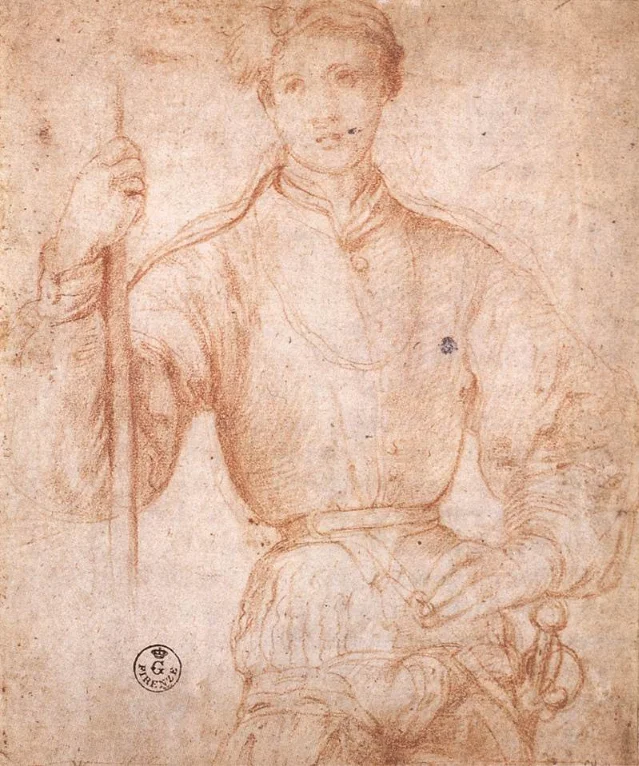
Before arriving at the finished panel, Pontormo worked out the composition in red chalk. The preparatory drawing survives in the Gabinetto dei Disegni e delle Stampe of the Uffizi in Florence. 7 When the Uffizi organized an exhibition comparing his drawings to the paintings in 2018, curators noted something telling: the drawing shows the figure more frontally, with less contrapposto, than the finished portrait. The sketch is almost purely a study of clothing. As the exhibition text explained, "by choosing a frontal perspective to concentrate on the aspects that would have been hard to gather from a lateral perspective, the artist concentrates on his subject's clothing, rather than his facial features. So the sketch does not reveal the ambition of a portrait so much as a detailed study of his outfit." 7
This detail matters for the identity debate. If Pontormo was primarily studying costume, his choice of costume was highly specific.
Reading the picture: every object is an argument
A halberd, for a Florentine viewer in 1529, was not a generic weapon. It was specifically the weapon of the fanciulli — the young militia volunteers who guarded the city walls during the siege. To carry one in a portrait was to announce your role in the republic's defense.
The coat is a pale ivory-gold giornea, a fitted over-tunic. The buttons running down the chest are ivory or bone. Blue-white shirt cuffs break at the wrists. The gold chain looping across the chest signals aristocratic birth. The scarlet breeches are cut in the fashionable puffed style, cross-gartered at the knee. The leather belt is broad and dark, the sword's hilt visible at the hip. The Web Gallery of Art's description catches the technical precision of the rendering: "the burnished metal of the hand-guard, the leather of the thick belt, the fine grain of the wooden halberd, the gold of the light chain" — Pontormo depicts each material differently, distinguishing the lustre of metal from the grain of wood from the softness of cloth. 8
The background is unusual: a flat plane of deep olive-green and black, painted to suggest the stones of a defensive wall or a stretch of drapery — not a landscape, not an interior, barely a setting at all. Against this near-abstract ground, the figure's reds and creams jump forward with extraordinary force. Pontormo used the strong frontal light to model the fabric precisely, so that every button casts a shadow and every fold has weight, while the darkness at the edges compresses the figure into the canvas, creating a claustrophobia that the boy's own defiant stare refuses to acknowledge.
At the top of the red beret — the beretta — sits the gold medallion. It depicts Hercules wrestling Antaeus: Hercules lifting the giant off the earth, which is the source of Antaeus's power. Here is the painting's most contested inch.
The question that has never closed
Giorgio Vasari — Pontormo's contemporary, sometime rival, and eventual biographer — wrote in his 1568 Lives that Pontormo, during the siege of Florence, made "a most beautiful work, a portrait of young nobleman Francesco Guardi as a soldier." 1 Birth records in Florence confirm that a Francesco Guardi was born to the Guardi family in 1514. 9 That would make him fourteen or fifteen years old during the siege — an age entirely consistent with the face in the painting.
But in 1612, when a member of the Riccardi family died in Florence and his estate was inventoried, the list described this painting as a portrait of "the most illustrious Duke Cosimo in his youth." 1 Cosimo I de' Medici (1519–1574) became Duke of Florence in 1537, after his predecessor Alessandro was assassinated. He was eighteen at the time — closer to the young man's apparent age in the painting. In 1537, after Cosimo's victory at the Battle of Montemurlo crushed a republican attempt at restoration, a triumphal portrait commission would have made perfect political sense. 10
And the medallion: Hercules and Antaeus was the personal badge of the young Cosimo I. 9 That detail is the Cosimo camp's strongest argument. Why would a Florentine teenager defending the republic against the Medici choose to wear the Medici heir's own heraldic device?
Janet Cox-Rearick, the Hunter College professor who is the leading authority on Pontormo's drawings, argued the Cosimo case in the Christie's catalogue when the painting was sold in 1989. 11 In 2012, a paper in Rheumatology International by G. M. Weisz and colleagues compared the left-hand anatomy of the Halberdier with three confirmed Cosimo portraits and with the Duke's surviving skeletal remains, arguing that a distinctive knuckle deformity is consistent across all sources and identifies the sitter as Cosimo. 12
Elizabeth Cropper, whose 1997 Getty monograph on the painting remains the most thorough single-object study in the museum's history, made the definitive case for Guardi. Her core arguments: Vasari's account is the earliest evidence and it is direct, not inferential. The face does not resemble reliable portraits of Cosimo by Pontormo or Bronzino. The 1612 Riccardi inventory very likely misread Vasari's own Lives, where a Pontormo portrait of Cosimo and his mother is mentioned — but it was commissioned for the Castello and would not have ended up in private Florentine hands. If the painting were a state portrait of the new Duke, it would have entered the Medici collections, not drifted into a Riccardi estate list. 9
Cropper also challenged the medallion argument directly: Hercules and Antaeus was not exclusive to Cosimo. The myth of Hercules as Florentine civic hero was ancient and pervasive — the Florentine Republic itself used Hercules as a symbol. A young republican soldier might perfectly well have worn a Herculean badge. 9
Roman Kholev, writing in Actual Problems of Theory and History of Art in 2021, gave the most precise formulation of why the debate is genuinely unresolvable: "The Pontormo portrait admits directly opposing monarchic (Cosimo de' Medici) and republican (Francesco Guardi) interpretations." More than that, he argued that this ambivalence is structural — that Cosimo I's court culture deliberately absorbed republican Florentine symbols, including the Hercules imagery, to legitimize Medici rule. 13 The painting may be both things. A republican boy warrior who happens to wear the future Duke's badge, or a Duke-to-be who posed as a republic's defender — the ambiguity itself is the meaning.
George Goldner, the Getty curator who handled the purchase, put it more plainly to a reporter in 1989: "It's a very complicated art historical puzzle. It's not a black and white case, and besides it really doesn't matter." 11 This is the curator's traditional dodge, and it has an element of truth — the painting's power does not depend on resolving the question. But the question will not go away.
The Getty currently gives the title as Portrait of a Halberdier (Francesco Guardi?) — the question mark is load-bearing. 1
The painting's hidden companion
The Halberdier did not always face the world alone. It originally had a cover: a small, separate panel of Pygmalion and Galatea painted by Agnolo Bronzino, Pontormo's most gifted student. 8 The Ovidian myth — a sculptor who falls in love with his own statue, prays to Venus, and watches the ivory come to life — was a standard Renaissance vehicle for thinking about the power of images. The painting folded over the Halberdier like a book cover, protecting the portrait while simultaneously commenting on it. 7
This was a common format for expensive portraits in sixteenth-century Italy: an outer panel, usually allegorical, that hid the sitter from casual view and gave the work a second level of meaning. The Uffizi curators described the Bronzino cover as a "collaboration between the two" — Bronzino used Pontormo's own preparatory drawings as sources for the figures of Pygmalion and Galatea. 7 The cover has since been separated from the Halberdier. The metaphor of the statue come to life — the idea that painting surpasses sculpture by giving color and breath to stone — hovers behind the portrait even in the cover's absence. 8
Bronzino went on to become the great official portraitist of the Medici court — precisely what his master Pontormo refused to be, at least in temperament. The contrast Christopher Knight drew in the Los Angeles Times is exactly right: "There's no one like him — not even his star pupil, Agnolo Bronzino, whose elegant iciness is anything but restless." 14 Bronzino's sitters are calm, composed, slightly frozen. Pontormo's boy is none of these things.
460 years of wrong attributions
After its creation, the painting vanishes from the record until 1612, when it surfaces in the posthumous inventory of Riccardo Romolo Riccardi in Florence. 1 The Riccardi family — wealthy bankers who had purchased the Palazzo Medici on the Via Larga from the Medici themselves in 1659 — held it for nearly two centuries. From 1612 to 1807, the painting stayed in Florence, its authorship presumably never questioned. 9
Then it crossed the Alps and entered the chaotic world of post-Revolutionary French collecting — and promptly began to be misidentified.
Jean-Baptiste Pierre Lebrun, the Paris art dealer, acquired it before 1807 and sold it that year under the name of Gianfrancesco Penni, a minor painter from Raphael's workshop. 1 Penni — known as "Il Fattore" — was a convenient holding attribution: competent, recognizable, not wildly implausible for a painting of this quality in this manner.
The buyer at the 1810 Lebrun sale was Cardinal Joseph Fesch, Napoleon's maternal uncle and one of the most voracious collectors in early nineteenth-century Europe. Fesch eventually accumulated more than sixteen thousand works. 9 His inventory of 1839 describes the painting under the name of Bronzino; an 1841 list attributes it to Andrea del Sarto. At the Fesch estate sale in Rome in 1845, it went as Andrea del Sarto again, and was purchased by a Monsieur Warneck, likely acting for Dr. Leroy d'Etiolles, a Parisian collector who kept it as a work by Gianfrancesco Penni (Il Fattore). 1
At the Leroy d'Etiolles estate sale at the Hôtel Drouot in Paris in February 1861, the painting was bought by a Monsieur Gros and passed to Princess Mathilde Bonaparte, Napoleon I's niece and a formidable intellectual hostess whose salon drew Flaubert, Sainte-Beuve, and the Goncourt brothers. 9 At her sale in May 1904, catalogued as a work by Alessandro Allori (a late Florentine Mannerist, sometimes called "il Bronzino" — adding to the confusion), it was purchased by Eugène Kraemer. 1 The panel-to-canvas transfer almost certainly occurred somewhere in this stretch of French ownership, probably in the second half of the nineteenth century.
It was during the Mathilde Bonaparte years or shortly afterward that the painting's true authorship began to resurface. By the time it reached James Stillman — the New York banker who helped build what became Citibank and who paid around $37,000 for it around 1914–1918 11 — it was recognized, at least in specialist circles, as Pontormo. Frank Jewett Mather published the first English-language monographic article on it in Art in America in 1922. 1
Stillman died in 1918, and the painting passed to his son Charles Chauncey Stillman, then through the family estate to Chauncey Devereaux Stillman — Charles's son — after a sale at the American Art Association in New York on February 3, 1927, where Walpole Galleries purchased it and immediately resold it to the younger Stillman. 1 The Stillman family had paid roughly $37,000. It would be worth considerably more.
Nineteen years at the Frick
Chauncey Devereaux Stillman was a New York philanthropist who held the Halberdier for sixty-two years — the longest single ownership in the painting's documented history. Starting in 1970, he lent it to the Frick Collection on Fifth Avenue, where it hung for nearly two decades, acquiring the patina of a semi-permanent fixture. 15 In 1981, Stillman wrote to the Frick expressing his intention to donate it. By 1987 he had changed his mind. 11
In March 1989, the painting was quietly removed from the Frick's walls. Stillman died in January 1989, at eighty-one. His estate decided to sell.
$35.2 million and a new world record
On the evening of Wednesday, May 31, 1989, Christie's New York offered the Halberdier as lot 72 in a sale of Old Master paintings from the Stillman estate. The estimate was $20 to $30 million. 2
Bidding opened at $12 million and rose in $500,000 increments. Jeffrey Deitch, bidding for an anonymous client, dropped out at $27 million. At $28 million, Julian Agnew, of the London firm Thomas Agnew & Sons acting for the Getty, entered the room. He won at $35.2 million — including buyer's premium — more than three times the previous world record for an Old Master painting, which was the $10.45 million the Getty had paid for Mantegna's Adoration of the Magi in 1985. 11 The 143-lot sale totaled $45.36 million; the Pontormo alone accounted for more than three-quarters of that. 2
George Goldner, the Getty's curator, was in the room. "We're absolutely thrilled," he said afterward. "It's a very good price, and it's the finest picture to be sold in any field in the last 10 years. You could say it was a bargain." 11 Richard Feigen, among the most experienced Old Master dealers in New York, agreed: "It's a great masterpiece…I think the Getty made a brilliant purchase. They didn't pay too much." 11
Tom Wolfe, the writer, who had known Chauncey Stillman personally, was also there. "He was a great man," Wolfe said. "He didn't seem to make much of a fuss over his paintings, certainly not the kind of art fever that surrounds it now." 11 The proceeds went to Stillman's charitable Homeland Foundation, which supported Catholic education and medical missions.
The record stood until 2002. The Stillman family's $37,000 purchase in 1927 had appreciated approximately 950-fold in sixty-two years. 11
Exhibition history and scholarly presence
The painting entered a vigorous public life once the Stillmans acquired it. It appeared at the Art Institute of Chicago's A Century of Progress exhibition in 1933, 1 at the New York World's Fair in 1939, 1 and at the landmark 1956 Mostra del Pontormo e del primo manierismo fiorentino at Palazzo Strozzi in Florence, the exhibition that first systematically defined the Florentine Mannerist canon. 1
In 2018 and 2019, the Uffizi and the Getty mounted Pontormo: Miraculous Encounters, pairing the Halberdier with the red-chalk preparatory drawing and with the Visitation from Carmignano — the first time that painting had ever left Italy. 7 The Getty exhibition also brought together Pontormo's Portrait of a Young Man in a Red Cap and four drawings, giving Los Angeles audiences the closest thing possible to a comprehensive view of an artist who produced very few finished paintings and almost never repeated himself. 16
The painting is not currently on permanent display at the Getty Center. 1 It appears in rotation with the rest of the permanent collection.
The boy who will not be resolved
What the painting finally is — portrait of a republican soldier or dynastic trophy of his conquerors — may genuinely be undecidable. Kholev's formulation is the most intellectually honest: the iconographic ambivalence "is explained by the nature of Florentine court culture and Cosimo's representation, which assimilated ancient republican symbols of Florence and used it to glorify the Duke and the Medici dynasty." 13 The Medici had every reason to appropriate republican imagery; the republic had every reason to claim Herculean heroism for its defenders.
But there is a simpler way to state what makes the Halberdier genuinely singular. In the entire tradition of European portraiture, very few painters before 1600 thought a teenager's face worth studying on its own terms — as a psychological subject rather than a dynastic symbol. Pontormo looked at this boy, whoever he was, and saw something he thought the world needed to know: that the gap between the soldier's posture and the child's face was not a failure of the sitter's courage, but the most honest thing about him. The swagger is real. So is the softness behind it. The painting holds both at once, without resolving either — which is, perhaps, the only truthful way to paint a person who is about to be tested beyond anything he can imagine.
The fortress wall behind him is the city wall. The city is surrounded. The boy doesn't know yet how it ends.
Cover image: Pontormo (Jacopo Carucci), Portrait of a Halberdier (Francesco Guardi?), c. 1528–30. J. Paul Getty Museum, Los Angeles (acc. 89.PA.49). Getty IIIF image, CC0. Getty Open Content Program
参考来源
- 1Portrait of a Halberdier (Francesco Guardi?) — J. Paul Getty Museum
- 2Getty Pays Record Price for Old Master Painting — Los Angeles Times
- 3Pontormo — Wikipedia
- 4Mannerism: Bronzino and his Contemporaries — The Metropolitan Museum of Art
- 5Mannerism — Wikipedia
- 6Siege of Florence (1529–1530) — Wikipedia
- 7Miraculous encounters: Pontormo from drawing to painting — Uffizi Galleries
- 8Francesco Guardi as a Halberdier by Pontormo — Web Gallery of Art
- 9Pontormo: Portrait of a Halberdier — Getty Museum Studies on Art (Elizabeth Cropper)
- 10Portrait of a Halberdier — Wikipedia
- 11Old Master Nets Record $35 Million — Judd Tully / The Washington Post
- 12Who Was Pontormo's Halberdier? The Evidence from Pathology — Rheumatology International
- 13Interpreting Pontormo's Halberdier: Francesco Guardi or Cosimo I de' Medici? — Actual Problems of Theory and History of Art
- 14A boldly divine visit — Los Angeles Times (Christopher Knight)
- 15Pontormo's Portrait of a Halberdier — The Frick Collection
- 16Portrait of a Halberdier (Francesco Guardi?) — Google Arts & Culture / Getty Museum
围绕这条内容继续补充观点或上下文。